Story points vs hours: the honest case for each, and when to estimate in hours
Story points vs hours, from the primary sources: what each estimate is good for, when hours win (client work, small tasks), and how teams use both.
Short answer: on story points vs hours, points are a relative measure of effort that helps a stable team forecast over many sprints; hours are an absolute measure that a client, a budget and a timesheet can all read. Estimate in hours when the work is billed or budgeted by the hour, when tasks are small and well understood, or when the team changes often. Use points when a stable team forecasts a long backlog and nobody outside the team needs the number in time.
This argument usually runs on opinion. We went back to the people who shaped it: Mike Cohn of Mountain Goat Software, Ron Jeffries, Scrum.org, Scrum Inc. and Atlassian's agile guide. They agree on more than the arguments suggest.
What story points are, according to their advocates
Atlassian's guide defines a story point as a unit of measure that expresses the relative effort required to complete a user story, considering complexity, risk and the amount of work, "rather than specific hours or days."
Mike Cohn is precise about what they measure. In It's Effort, Not Complexity he writes that "story points are an estimate of the effort involved in doing something," based on the volume of work, the risk or uncertainty, and the complexity. Complexity counts only to the extent it changes effort.
And points are not part of Scrum itself. The Scrum Guide (2020) does not mention story points, velocity or any estimation unit. Barry Overeem's Scrum.org post Myth 9: Story Points are Required in Scrum makes the same point: "there is no mention of Story Points, hours, ideal days, gut feeling, t-shirt sizes or any other unit."
The case for story points
- They are relative, so people agree faster. "Is this bigger than that one?" is an easier question than "how many hours?" Cohn: "Story points work because they are relative units of measure."
- They survive differences between people. A senior and a junior developer can agree a story is a 5 while disagreeing on hours. Cohn's point is that points "are still about effort, but the amount of time it takes to complete each point is not fixed at the same amount for all team members."
- They absorb the rest of the job. Atlassian's guide argues that dates don't account for the non-project work that creeps into our days: emails, meetings and interviews. Velocity measured in points already has that overhead baked in.
- Their advocates say they forecast better. Scrum Inc. lists "estimating in hours instead of relative effort" as a common mistake, saying "time-based estimates introduce variability and reduce forecasting accuracy."
The case for hours
- Everyone outside the team thinks in hours. A client approving a change request, a finance lead checking a budget and a developer filling a timesheet all read hours without translation.
- You can compare the estimate with what happened. An hour estimate sits next to tracked hours in the same unit, which is the whole basis of an estimated vs actual hours report. A points estimate cannot.
- Small, familiar tasks don't need abstraction. "Update the copy on the pricing page" is a two hour job. Debating whether it is a 1 or a 2 adds a step without adding information.
- New or changing teams have no velocity yet. Points become useful once a stable team has a few sprints of history. Scrum Inc.'s Yesterday's Weather pattern starts from the average of the last three sprints. A team that changes every month never gets there.
Even the history of points runs through hours. Ron Jeffries recalls that early Extreme Programming (XP) teams estimated in "ideal days" and multiplied by a load factor (which tended to be about three) to get real time; "points" was a later name for those ideal days. He adds: "I like to say that I may have invented story points, and if I did, I'm sorry now."
Story points vs hours: where each one fits
| Situation | Better fit | Why |
|---|---|---|
| Client work billed by the hour | Hours | The client sees hours; a points estimate needs translating anyway |
| Fixed budget in hours, agency or contractor | Hours | You need to know early when an issue is eating the budget |
| Small, well-understood tasks and bugs | Hours | Fast to estimate, easy to check |
| Team composition changes every few weeks | Hours | No stable velocity to forecast from |
| Stable product team, long backlog, release forecasts | Points | Relative sizing plus velocity averages out over many sprints |
| Large, uncertain features far from being started | Points | Relative size is all you can honestly say yet |
| Estimates used to judge individuals | Neither | Atlassian's guide calls this a misuse of points; it corrupts hours too |
The hybrid most teams end up with
Cohn himself describes a mix. He still recommends that backlog items get "quick, high-level estimates in story points" for longer-range planning. For the next sprint, he prefers capacity-driven sprint planning: the team takes one backlog item at a time, roughly identifies and estimates its tasks, and stops when the sprint feels full. Those task estimates are in hours. His reason is that velocity is too variable for one sprint; in his experience it "bounces around in about a plus or minus 20% range."
For agencies the hybrid often runs the other way round. The client-facing estimate is in hours because the contract is, and the team may still play planning poker internally to surface disagreement. Our post on agency billable hours puts it simply in its second step: estimate in hours, even if you also use points.
What doesn't work is a fixed conversion. Cohn's advice is blunt: "Equating story points to a set number of hours is a bad idea. Don't do it." If 1 point always means 8 hours, you have an hour estimate with extra steps, and you lose what points were for.
Where Notch stands
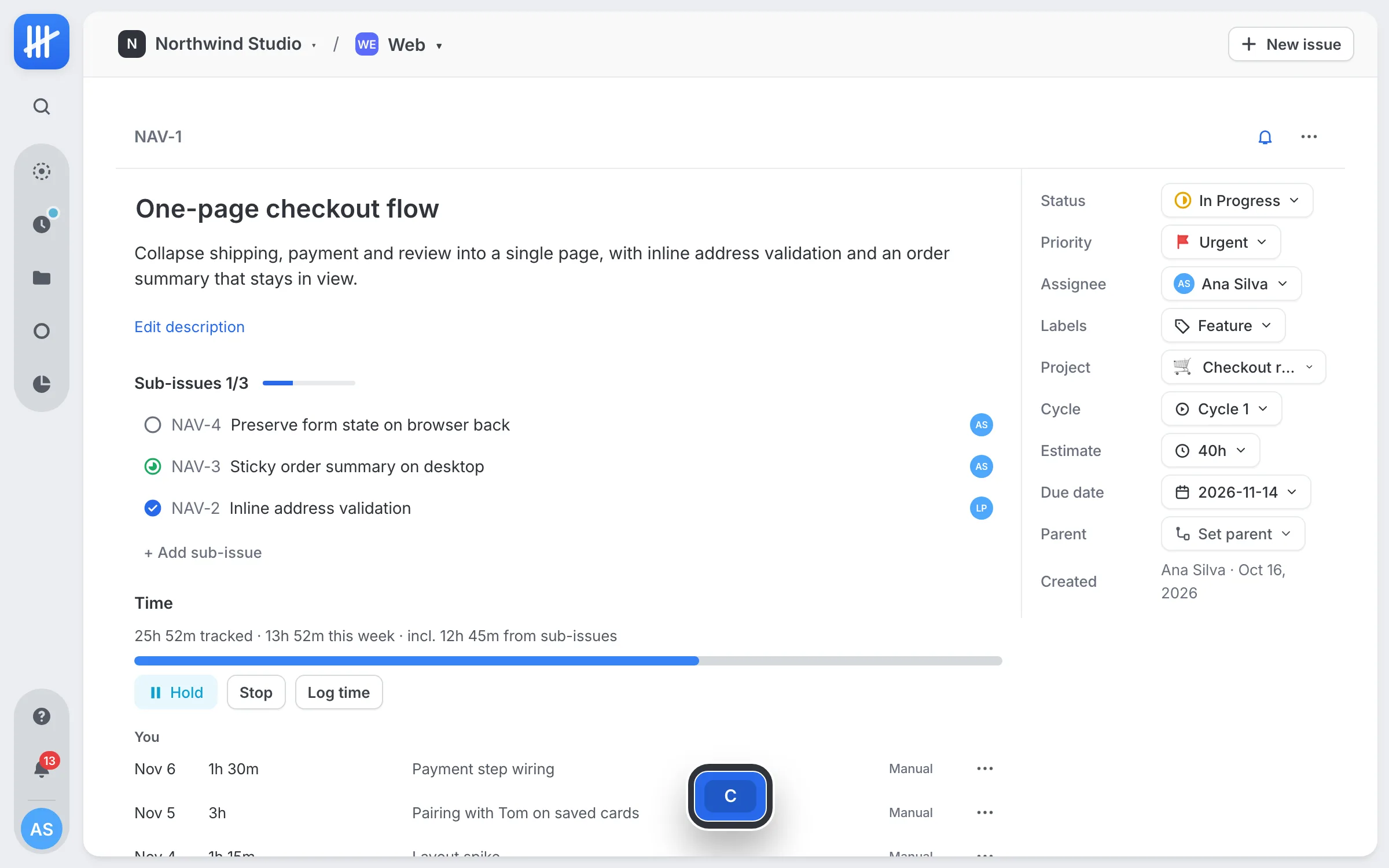
Notch estimates in hours, and only in hours. It has no story points field. We built it for our own agency, where clients pay for hours and every estimate gets compared with the time tracked on the same issue. Each issue shows its estimate, a timer, and a bar that fills as time is tracked, so an issue running past its estimate is visible while the work is happening.
If your team sizes a long product backlog in points and forecasts releases from velocity, a tracker with points support (Jira, Linear and many others) is the better fit, and that is a reasonable choice. If your work is billed or budgeted in hours, estimating in the unit you report in saves a translation step every week. When you plan a cycle that way, our five-step sprint capacity planning method shows the arithmetic.
How to decide for your team
- Who reads the estimate? If anyone outside the team needs it in time or money, estimate in hours.
- How stable is the team? Points need a few sprints of steady velocity before they forecast anything.
- How big and how certain is the work? Small, known work suits hours; big, fuzzy work suits relative sizes.
- Will you compare estimates with actuals? Only hours can sit in the same column as tracked time.
Pick one unit for each purpose, write it down, and don't convert between them.
Questions people ask
Does Scrum require story points?
No. The Scrum Guide does not name any estimation unit. Story points are a common team practice, and Scrum.org and Scrum Inc. both say so.
How many hours is one story point?
There is no fixed conversion, and the people who popularised points advise against making one. Mike Cohn calls equating story points to a set number of hours a bad idea, because it removes the reason to use points at all.
Should an agency estimate in story points or hours?
If clients pay by the hour or approve budgets in hours, estimate the billable work in hours, because that is the unit the client sees. A team can still size its backlog in points for its own planning.
Can you use story points and hours together?
Yes. A common hybrid is points on backlog items for longer-range forecasts and rough task hours for planning the next sprint. Mike Cohn calls the second part capacity-driven sprint planning.